
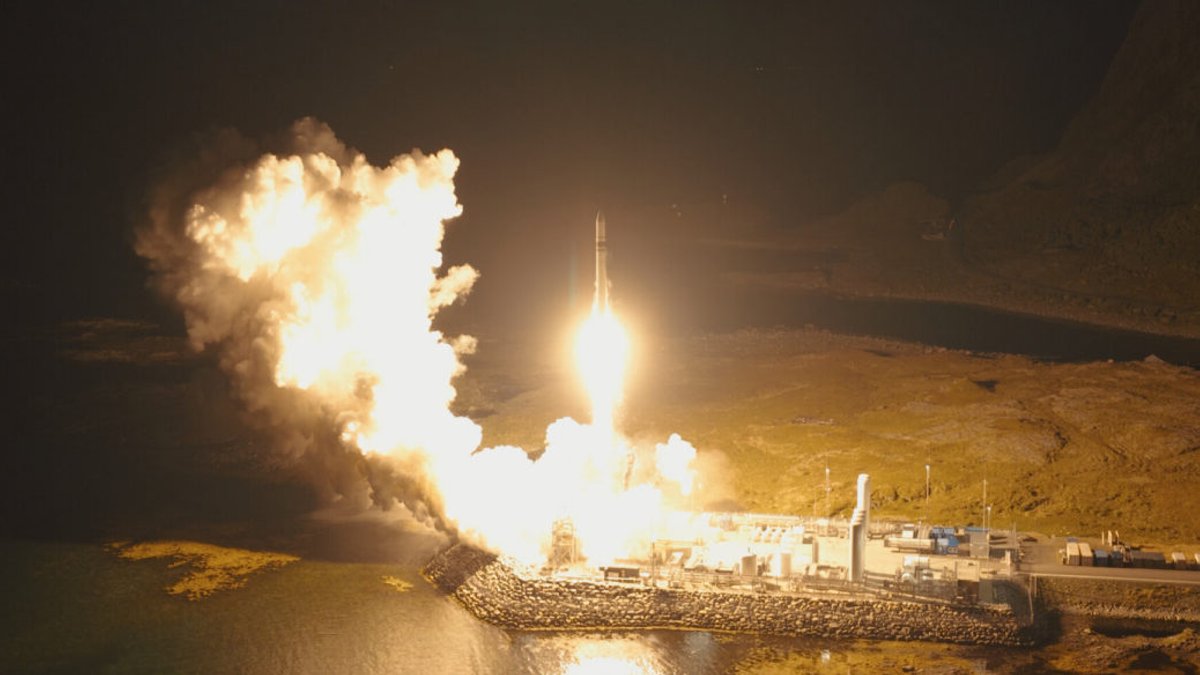
Isar Aerospace lifted its two‑stage Spectrum launch vehicle into low Earth orbit on Saturday, marking the first fully commercial orbital mission launched from Europe.
Saturday’s flight
The vehicle rose from Andøya Spaceport in northern Norway at 4:12 pm EST, just as the Arctic twilight faded. Seven minutes later the booster reached orbit, deploying five CubeSats and a technology demonstrator that will be used for on‑orbit experiments.
Ignition came from nine Aquila engines burning propane and liquid oxygen, delivering about 150,000 lb of thrust. After a two‑and‑a‑half‑minute first‑stage burn, the booster separated and fell into a pre‑designated zone in the Norwegian Sea, where recovery teams monitored its splash‑down trajectory.
The single‑engine second stage accelerated to roughly 5 mi s⁻¹, then coasted before a brief reignition to circularize the orbit at about 300 mi altitude. Ground stations confirmed contact with at least one payload, indicating a successful deployment and opening the way for additional missions.
Company origins and funding
Three Technical University of Munich students founded Isar Aerospace in 2018, naming the firm after the river that runs through Munich. Over eight years the team grew to nearly 500 staff and raised about $1 billion in private capital, a sum that reflects strong investor confidence in Europe’s emerging launch sector.
The firm did not receive a large upfront grant from the German government, though the German Space Agency (DLR) contributed €11 million in 2021 to support development. In the latest round, the European Space Agency added $230 million via its European Launcher Challenge, the largest award of the program and a clear sign of institutional backing.
Compared with other European launch startups, the company’s timeline mirrors the typical path of private vehicles in the United States, where a decade of development and substantial venture funding are common before achieving orbit. This parallel suggests that European entrepreneurs are following a proven model while adapting it to local market conditions.
Impact on the European launch market
Europe’s launch sector has long been dominated by government‑backed programs such as Ariane 6 and Vega‑C, which rely on subsidies to stay competitive. The entry of the firm introduces a privately funded alternative that could pressure incumbents to lower prices and accelerate innovation.
Officials see the development as a step toward greater strategic autonomy, reducing reliance on foreign providers like SpaceX. The German chancellor praised the flight as the “beginning of a new era,” emphasizing the security benefits of an indigenous launch capability for European satellites.
Industry analysts note that while the vehicle’s payload capacity of about one metric ton sits between the smaller Electron launcher and the larger Vega‑C, it fills a niche for dedicated small‑satellite missions that currently lack cost‑effective options. This niche positioning may attract a steady stream of customers seeking rapid, on‑demand access to orbit.
Future production and expansion plans
Isar plans to build five more vehicles in its current production line and is constructing a 10‑acre factory near Munich capable of 40 launches per year once fully operational. The new facility will incorporate modular assembly stations, allowing parallel work streams and reducing build time for each rocket.
The company also eyes a second launch site in Canada and potential operations from Kourou, French Guiana, broadening its geographic footprint and providing customers with flexible launch windows from multiple latitudes.
CEO Daniel Metzler said the firm will push to “streamline” the design, likening the process to an IKEA approach where many units can be assembled quickly without sacrificing quality. He emphasized that modularity and standardization are central to the strategy.
He hinted at a larger, reusable launch system under development, though details remain scarce. The prospect of reusability could further differentiate the company from competitors that rely on expendable stages.
The next steps involve repeating the Saturday flight on a regular cadence, a challenge that typically takes several years for new launch providers. Customers already lined up include the ESA and commercial firms such as Astroscale, which focuses on in‑orbit servicing and debris removal.
They are preparing detailed integration plans for upcoming missions, ensuring that payloads will fit within the vehicle’s fairing and meet all safety requirements.
Momentum builds as the team finalizes certification paperwork and coordinates with international range authorities.