
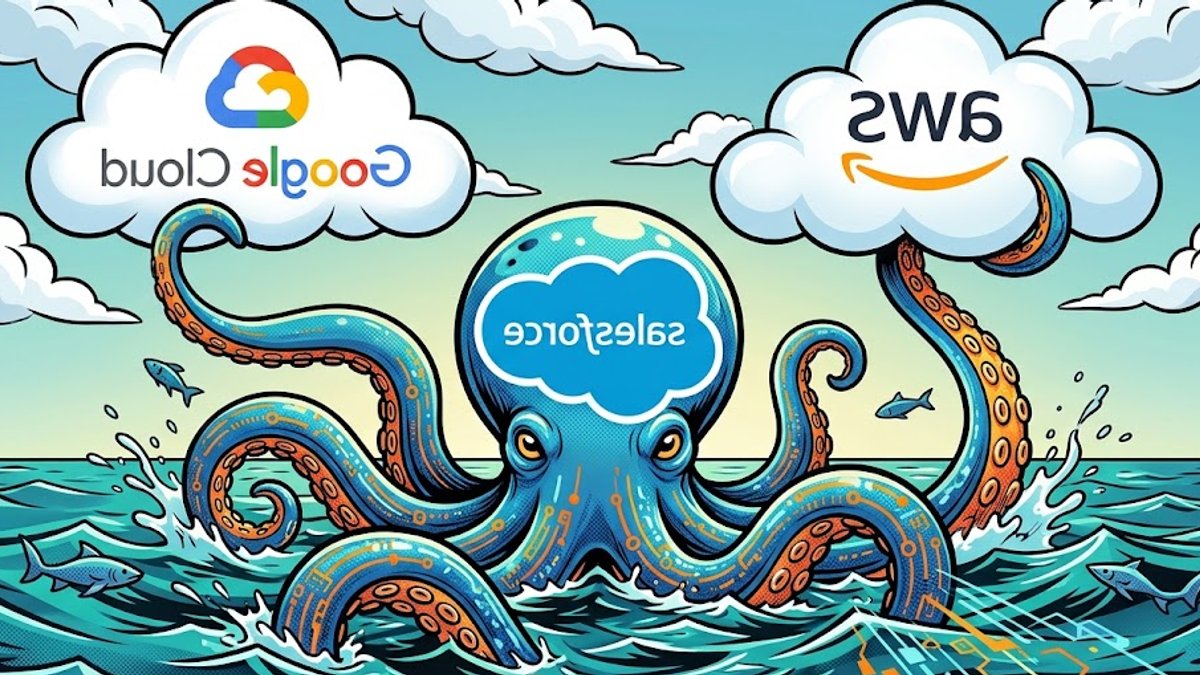
Salesforce Inc. is expanding its integrations with Amazon Web Services Inc. and Google Cloud to support AI agents and break down enterprise data silos. The partnerships, announced at Dreamforce 2026, aim to bring customer relationship management data, AI agents, and workflows into the public cloud environments of its partners.
The company’s work with AWS is focused on bringing AI agents into the daily work environment of enterprises, while enabling broader model choices for users and enhanced voice capabilities. For instance, Amazon Quick will be able to access live CRM data from Salesforce and leverage it to perform autonomous work on behalf of sales and customer service teams.
Enhanced Integrations with AWS
Salesforce is integrating a number of AWS agents, including the AWS DevOps Agent, within its enterprise-focused messaging and collaboration tool, Slack. With the AWS DevOps Agent in Slack, teams will be able to resolve infrastructure problems without having to leave the platform.
Salesforce’s Agentforce platform is being given access to Amazon Bedrock’s library of foundation models, including those from Anthropic PBC, OpenAI Group PBC, and Nvidia Corp., meaning users have more choice about how to power their Agentforce agents. The company is also extending its Data 360 Zero Copy integration to AWS Glue-managed Apache Iceberg tables and the Amazon Aurora database.
AWS Vice President of Data and AI GTM Rahul Pathak said enterprises need to build on their own data, with the applications and infrastructure they’re already using, to get the most value out of their AI investments. The new integrations with Salesforce give customers data access without migration, model choice at the right economics, and AI agents where their people already work, he said.
A Unified Infrastructure for AI Agents
Salesforce is also announcing a number of similar integrations with Google Cloud, with the goal of building a unified AI stack. The integration will enable cross-platform agent reasoning and actions that run on shared infrastructure, with Salesforce workloads brought onto Google Cloud via Hyperforce, a framework for running the company’s software on public cloud platforms.
Read Also: Altman and Musk back Amodei’s call to slow AI development
Salesforce President and Chief Trust and Infrastructure Officer Meir Amiel said the infrastructure underneath the company’s customers will change, but the trust they’ve built with Salesforce will remain the same. Hyperforce running natively on Google Cloud will extend the same security, compliance, and resilience standards that Salesforce holds itself to, he said.
Salesforce is integrating its Commerce Cloud platform with the Universal Commerce Protocol, making it possible for shoppers to discover and purchase products from directly within Google Search or Gemini, with payments processed via Salesforce’s secure infrastructure. The company is also integrating Gemini Enterprise with Tableau’s data analytics and visualization capabilities, to ensure that every response is grounded in Salesforce data.
The integration with Google Cloud is expected to support live customer traffic, with broader customer migrations to take place in the fourth quarter. Kevin Ichhpurani, president of the Global Partner Ecosystem at Google Cloud, said that by bringing Salesforce into Gemini Enterprise, customers can now build trusted agents that reason across their business context and securely take action.
Salesforce’s Agent2Agent bidirectional audio support with Amazon Connect Customer over Websockets is also being enhanced, to provide real-time support for Agentforce users.
Expanding the Reach of AI Agents
Salesforce’s Agentforce platform is being integrated with Google’s Gemini Enterprise platform, allowing customers to develop agents powered by Google’s flagship AI model. This integration is expected to expand the reach of AI agents, enabling them to perform tasks such as sales pipeline health checks, account summaries, and case triage across various workflows.