
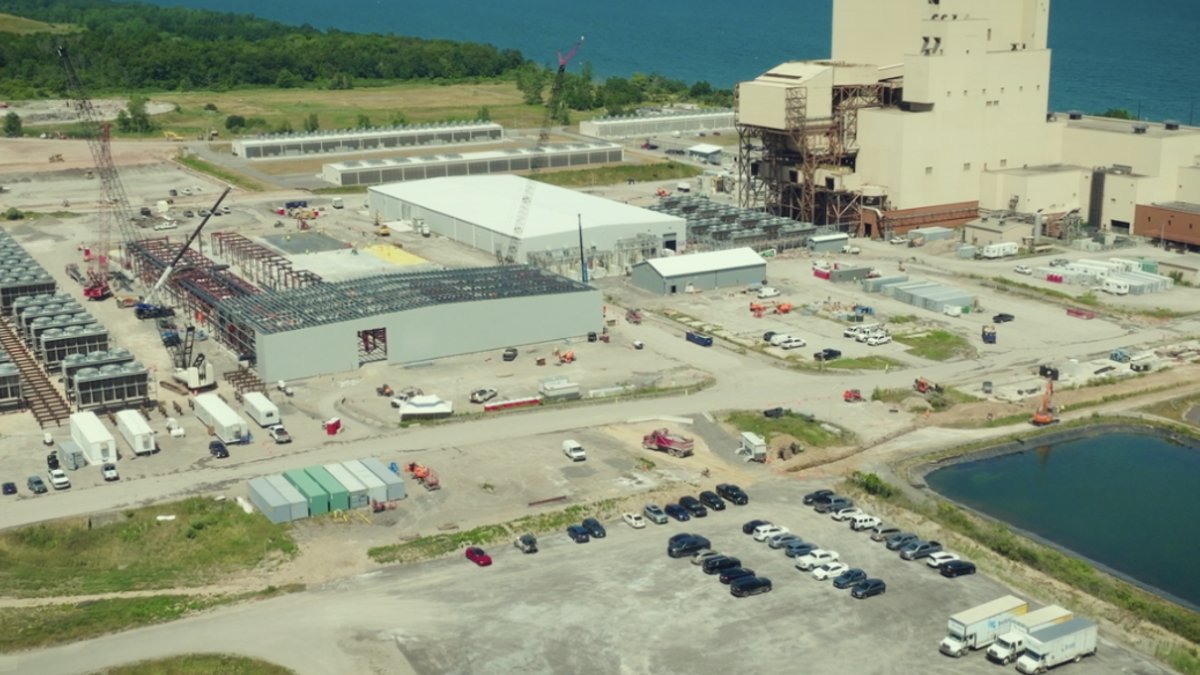
The Lake Mariner data center campus in Somerset, New York, represents one of the largest AI buildouts in the state, valued at $3.2 billion. Located on the site of a former coal mine on Lake Ontario, the project involves a complex network of stakeholders including TeraWulf, Fluidstack, Google, and Anthropic. In June, a fire at the still-unfinished site exposed significant gaps in emergency preparedness, revealing that local firefighters entered the building without a working alarm, a suppression system, or access to safety data sheets that had burned in the blaze.
Steve Matisz, chief of the Barker Fire Department, described the situation as his crew went in “kind of blind,” facing heavy black smoke from chemicals they couldn’t identify because the safety sheets meant to inform them had apparently burned up. “It’s been a difficult situation,” Matisz said, adding that he was unsure about the claim that the safety sheets had burned. The site’s safety documents were legally required to be available to first responders but were not. Following the incident, TeraWulf, which operates the facility, stated it was responsible for operational safety and emergency preparedness, including required safety systems and coordinating with local responders.
Safety Gaps Exposed by Fire
By mid-August, the situation had not improved according to Matisz. He confirmed that a representative from a Knox box program had visited the site, but regarding the hydrants, he remained direct: “As far as I know, [they] are still dry… I haven’t seen work done on them.” The fire did not halt construction, and no one was injured. However, the incident highlighted a broader trend in the AI infrastructure boom where responsibility is often fragmented across ownership, operation, and financing, making accountability for safety failures difficult to assign.
The development has drawn scrutiny from the local community, with Somerset Town Supervisor Jeffrey Dewart expressing frustration that the company’s communications team has remained unresponsive to requests for a meeting. At town board meetings, residents have questioned what the town receives in return for hosting such a large facility. According to a 2024 planning board presentation, the full buildout was projected to bring employment to between 35 and 40 people at a facility drawing up to 500 megawatts.
Broken Promises to the Town
This figure fell short of the promises made in 2019, when Somerset Operating Company, the landlord entity owned by TeraWulf CEO Paul Prager, applied for a power discount under a different scope that included 165 permanent jobs and $85 million in capital investment. New York Governor Kathy Hochul has acknowledged this gap, stating that data centers do not always deliver significant, long-term jobs. Pilar Thomas, a tribal energy law expert, noted that projects often employ hundreds of people for a brief construction period before stabilizing to a small staff, unless there is a specific commitment to training local workers.
Large data centers shift costs to the broader community rather than absorbing them entirely. Leah Stokes, a professor at the University of California, Santa Barbara, explained that a 24/7 load increases system costs for everyone, whether or not they benefit from the facility.
The Complex Energy Mix
The energy mix of Lake Mariner is also a point of contention. Kerri Langlais, TeraWulf’s chief strategy officer, said the claim rests on the regional grid mix rather than a specific power source. The site draws from the NYISO Zone A grid, which was 87 percent zero-emission in 2025. TeraWulf does not purchase renewable energy certificates to recharacterize the site’s electricity as clean, as Langlais stated that grid electricity cannot be traced to a particular generator.
Accountability issues extend beyond safety and energy into governance structures. Google’s warrant stake, similar to the one at Lake Mariner, was tested in a separate proceeding regarding TeraWulf’s purchase of a Maryland power plant. Public Citizen’s Tyson Slocum argued that unexercised warrants that could give a company control of 14 percent of another should be disclosed. TeraWulf declined to meet with communities around its Maryland facility, citing FERC rules that do not require such meetings, a stance that mirrors the company’s approach in Somerset.