
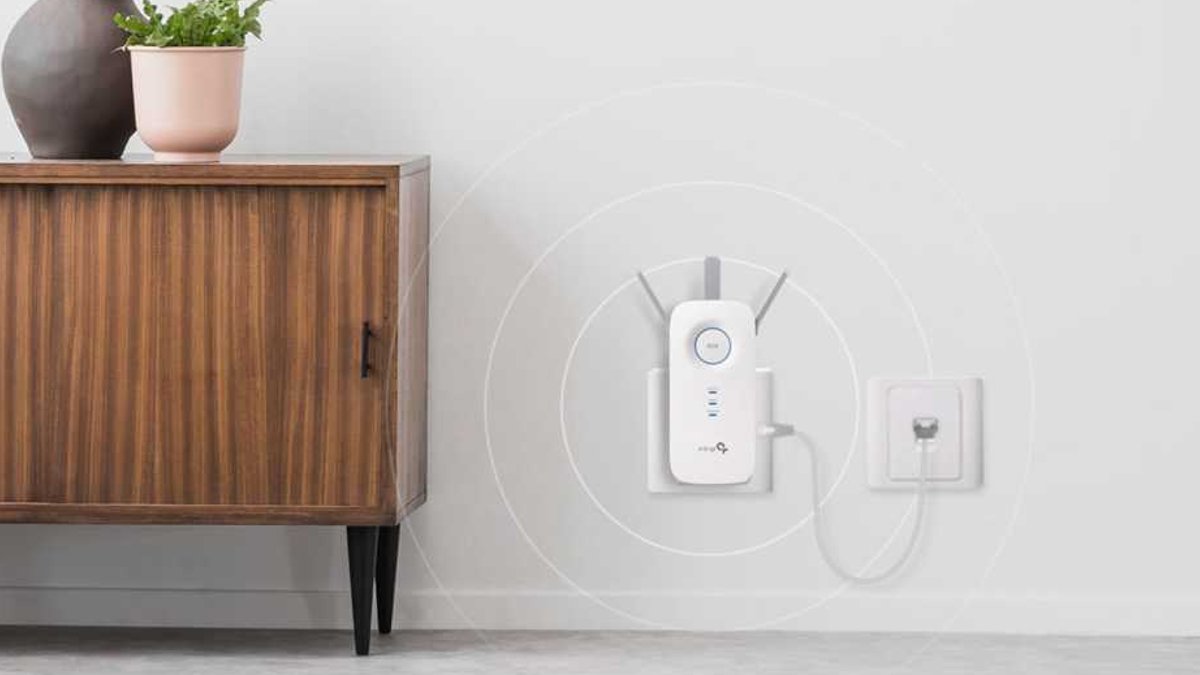
Weak Wi-Fi signal only in certain rooms is a common problem in many houses, especially larger apartments, detached homes, and buildings with thick walls. For those struggling with dead zones, a budget-friendly Wi-Fi range extender can often solve the issue without the expense of buying a new router. The TP-Link RE550 is currently on sale at Amazon for $34.90, marking a new all-time low price down from the standard street price of $49.99. This model is a popular choice in its category, holding an average rating of 4.3 stars across over 20,000 reviews and selling over 8,000 units in the past month alone.
The RE550 plugs into an outlet, connects to an existing network, and rebroadcasts the signal to boost coverage. It utilizes Wi-Fi AC1900 technology and operates simultaneously on both 2.4GHz and 5GHz bands, achieving speeds up to 600 Mbps on the 2.4GHz band and up to 1,300 Mbps on the 5GHz band. This dual-band approach allows multiple devices to connect without interfering with one another, preventing the wireless channels from becoming clogged. Setup is straightforward, using either a WPS button press, the TP-Link Tether app, or a web interface. The device is also EasyMesh compatible, which enables the creation of a seamless mesh network with a compatible router that automatically switches devices to the strongest signal as you move around the home.
Related: Claude to add AI watermarks to text
Because it features a built-in Ethernet port, the RE550 functions as more than just a repeater. It can be configured as an access point, turning a wired internet connection into a separate Wi-Fi signal for devices like laptops. This flexibility makes it a versatile tool for improving connectivity in various parts of a property. Users generally praise the simple setup and the improvement in coverage for the price, though a few critical reviews mention slower-than-expected speeds. Such performance dips are typical for extenders depending on environmental factors like walls, ceilings, and device positioning.
Purchasing a high-end router is not always necessary for fixing spotty connectivity. If a single room lacks a strong signal, a $35 extender can strengthen the wireless coverage in a broad area for a fraction of the cost of a new networking system. For those without the budget for a whole-home mesh setup or the ability to run wired cables, this option presents a practical solution. The device effectively bridges the gap between a router and a dead zone, providing adequate—or even good—signal quality where it was previously lacking.
Related: Communities seek control with data collectives
While a repeater is a cost-effective way to extend a network, it introduces a slight bottleneck since devices must connect to the extender to access the internet. This single point of failure means that if the extender itself loses power or malfunctions, the connection in that specific area is severed completely. A new router with a more powerful processor and multiple antennas might handle signal distribution differently, potentially offering more stability across the entire home than a single device placed in a corner.